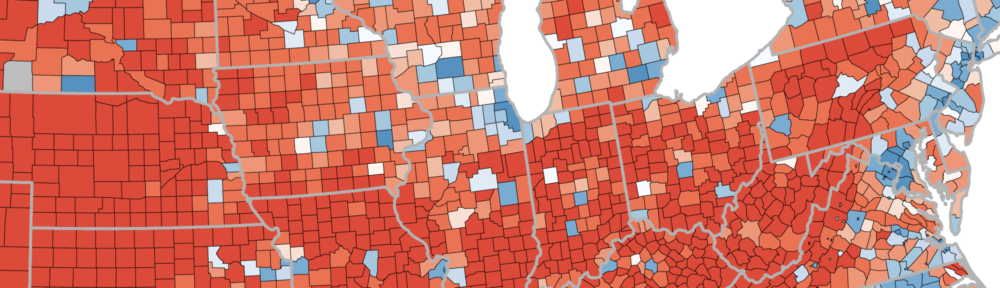
Who *doesn’t* have an opinion about Roe v Wade?

Given its prominence in political and legal debate for nearly 50 years, you might think everyone has an opinion about Roe v Wade. But there is variation in opinion holding that may surprise you.

Most telephone surveys ask about Roe without offering a “Don’t know” option, though if the respondent says “I don’t know” or “I haven’t thought about it” that is recorded. Typically this produces around 7-10% who volunteer that they don’t have an opinion. See examples here:

Academics have had a long running debate over whether surveys should explicitly offer “or haven’t you thought much about this?” as part of the question. Doing so substantially increases the percent who say they haven’t thought about an issue.

Despite more “don’t knows” when offered explicitly, the balance of opinion among those with an opinion doesn’t seem to vary with or without the DK option A debate remains if people have real opinions but opt out via DK or if when pushed will give answers but w weak opinions.

Online surveys present a new challenge. There is no way to “volunteer” a don’t know except to skip the item, which very few do. So should you offer DK explicitly and get more, or not offer it and get very few without an opinion?

In my @MULawPoll national Supreme Court Surveys we ask about a variety of Court cases. But obviously most people don’t follow the Court in detail so I believe we must explicitly offer “or haven’t you heard enough about this?” Doing so produces some 25-30% w/o an opinion on most cases.

So is the “haven’t heard enough/Don’t know” rate really around 10% or really around 30%? Clearly wording makes a big difference, but I think it pretty clear those who opt for “haven’t heard enough” are less engaged on an issue than those who give an opinion.

What is worth looking at here is not the absolute level of “haven’t heard” but how it varies across the population. The invitation to say haven’t heard opens this door to seeing how opinion holding varies, and at the very least shows those more and less engaged with the issue.

Here is opinion on overturning Roe, with 30.6% saying they “haven’t heard at all” or “haven’t heard enough” about the case. Of those WITH an option, 71% would uphold and 29% would strike down.

But look at who is more likely to say they haven’t heard enough and who is more likley to say they have an opinion.

To my surprise, it is the OLD who are more likely to have an option. The young at twice as likely to say haven’t heard enough.

I wonder if the intense battles over abortion in the 1970s-80s were seared into the political makeup of folks now in their 60s and up in a way that the issue simply hasn’t been for those in younger ages. A less interesting answer is the young simply pay less attention.

Other differences are more intuitive.

Ideological moderats are much more likely to say “haven’t heard” than those towards the endpoints of ideology.

But there is interesting asymmetry here with the left more engaged than the right.

Independents are more likely to say not heard than partisans, but as with ideology the assymetry shows Democrats more likely to have an opinion than Republicans. The salience of Texas SB8 as well as Dobbs has probably boosted Dem concern generally.

There is a small difference between born again Christians and all other respondents, but perhaps a surprise that slightly more born again folks say they haven’t heard enough about Roe.

White respondents are a bit less likely to say “haven’t heard” than are other racial and ethnic group members.

And finally, what about gender?

Hardly any difference in opinion holding.

To return to the academic literature on whether to offer a don’t know/haven’t heard or not, there is good evidence that pushing people to respond produces similar results and statistical structure as we see among those who offer opinions when DK is an offered option.

The variation we see in choosing “haven’t heard” also reflects willingness to respond beyond simply not having thought. Good work shows this general reluctance is part of the issue of non-response as well.

Those with intense positions on abortion naturally assume that most people are similarly intense. The results here show we should be cautious in assuming “everyone” has an opinion on Roe (or other issues.) And the variation in opinion holding is interesting, sometimes surprising.

Here is the wording we use for this item with all the response categories.

A followup on age: Older respondents are also more likely to have an opinion on a case concerning the 2nd Amendment and the right to carry a gun outside the home. It may be that younger people pay less attention to issues before the Court in general, and so the age effect on opinion holding on Roe may not be the generational difference I suggest above, but simply variation in attention to the Court.

However, this logit model of saying “haven’t heard” includes controls for education and voter turnout in 2020, with age continuing to play a role. That doesn’t prove it is socialization behind the effect, but does show that age effects remain statistically significant even when a number of other variables are included in the model.

Abortion cases, the Court and public opinion

On Dec. 1, 2021 the US Supreme Court heard arguments on Dobbs, the case challenging Mississippi’s ban on abortions after 15 weeks, and arguments to use the case to strike down Roe v Wade’s protection of abortion rights.

Some polling here.

The @MULawPoll national Supreme Court Survey asked in September and in November about both cases. I combine the data here as opinion did not change significantly between the two surveys.

We offer respondents the option to say “haven’t heard anything” or “haven’t heard enough” and about 30% pick that for each question (30.6% missing in table are the not heard.)

For Roe, of those with an opinion, 71% say the court should uphold Roe, 29% say strike it down.

There is more support, and a close division, on whether the Court should uphold Mississippi’s 15 week ban in Dobbs. 28% lack an opinion (missing).

Of those with an opinion on Dobbs, 54% would uphold the 15 week ban and 46% would strike down the law.

Looking an the joint response, of those w/ an opinion about both cases, half, 49.6%, would uphold Roe and strike down Dobbs. 29% would overturn Roe and uphold Dobbs

But 19% want to see Roe remain in effect yet accept greater limitations on abortion rights w Dobbs 15 week ban. Less than 3% would strike down both Roe and Dobbs.

The willingness to support Roe but accept restrictions has been common in polls about abortion. A majority of respondents say either “legal in most circumstances” or “illegal in most” but not legal or illegal in all cases.

Pew national survey data from May 2021 is typical of responses to this question. About 60% are in the “most but not all” categories, with 25% legal in all cases and 13% saying illegal in all cases.

As for what structures opinions about Roe and about Dobbs in my @MULawPoll national surveys, it is ideology that has the strongest effect, with party a bit less strong.

This chart shows the estimated probability of favoring overturning Roe and of upholding Dobbs by ideology.

The green line shows that across ideology people are less likely to say Roe should be overturned while the higher purple line shows the greater probability they favor upholding Dobbs. Ideology has a strong effect on both but upholding Dobbs has more support than striking Roe.

A similar pattern holds across partisanship, though the slopes are less steep than for ideology.

The contrast between Dems vs Reps and for very liberal vs very conservative is quite sharp in both charts.

Finally, here are multivariate models for opinion on striking down Roe and for upholding Dobbs. Education plays more of a role in structuring Dobbs but not for opinion on Roe. Born again Christians are more opposed to Roe and in favor of Dobbs, as one would expect.

Roe Model:

Dobbs Model:

The effects of race and marital status vary between the two cases, while gender is not statistically significant in either model, nor is age.

Our divisions over abortion are unlikely to, shall I say will not, go away regardless of how the Court rules. How much the ruling changes the status quo, and what new political movements it sets in motion, will be a topic for next summer and beyond as the Court’s decision sinks in.

Parties, partisans & perceptions: liberal-conservative locations 1972-2020

I’ve seen a cartoon going around showing the liberal-conservative ideology of the self and Dem and Rep parties. In the cartoon, the self and Rep party stay fixed while the Dem party moves far to the left. It is an effective graphic & rhetoric but how does it fit with data?

The American National Election Studies (ANES) has measured ideology of self & both parties on a 7-point scale since 1972. The points are labelled “extremely liberal”, “liberal”, “slightly liberal”, “moderate”, “slightly conservative”, “conservative” and “extremely conservative”.

How have ideological self-perceptions & party perceptions changed over time? Here are the means from 1972 to 2020. A mean of 4 is “moderate”. Until 2000 both parties were a point or so away from 4, Dems a little closer to 4 than Reps. Since 2000 both have moved out from the center.

In 2020 the Dem party was just over 1.5 points to the left of 4 and the Rep party was just over 1.5 points to the right of 4. Voters self-location has hardly moved, slightly right of center. The parties remain roughly symmetric though further left or right.

But what about how partisans see themselves, their party and the other party? Here self and own party match closely, with the other party far away. Dems see themselves & the party as more moderate than does the general public, 1 point or less to the left.

Dems used to see themselves as quite moderate, less than half a point to the left but have drifted left since 1998 so they now see themselves as 1 point to the left.

Dems also see the Rep party about where the general public sees it, just over 1.5 points to the right of center. How do Republicans see themselves & the parties? Next tweet please.

Republicans see themselves & their party as close together, and again about 1.5 points to the right, as does the general public. But they see the Dem party as considerably further to the left than does the general public, over 2 points to the left of center.

Reps see themselves & their party drifting right from 1 point right of center in 1992 to just over 1.5 to the right now.

Dems think themselves more moderate & their party more moderate than the general public does. They don’t push Rep party to the right, however. Reps put themselves & their party about where the public sees the GOP but perceive the Dem party much further to left than general public.

How about independents? they put themselves very close to the moderate center, and perceive each party about where the general public does, and roughly symmetrically, each party now about 1.5 points to left or right of center.

So what about that cartoon that’s been going around Twitter? It doesn’t reflect how the general public perceives the parties over time. The public sees both parties moving a bit out from the center over the last 20 years, but equally so.

But the cartoon does reflect the perceptions of Republicans of the Dem party pushing it well to the left of where the general public, or independents, sees it.

Data from American National Election Studies (ANES) 1952-2016 cumulative data file and ANES 2020 survey. There have been mode changes in recent years, with 2020 primarily conducted by web, with a mix in 2016. I’ve ignored these issues in the analysis here. Those failing to place themselves or the parties on the liberal conservative scale are set to missing and excluded from the analysis.

ANES website: https://electionstudies.org

Public opinion on Supreme Court reform

Since 2019 the Marquette Law School Supreme Court survey has asked national samples about their views on three frequently raised options for changing the structure of the U.S. Supreme Court, expansion of the Court, limiting the terms of the justices and limiting Supreme Court review of acts of Congress.SC

Expansion of the Court has become increasingly partisan with Democratic support rising by over 20 percentage points since 2019 while Republican opposition has grown by 10 points with little change among independents.

Majorities of all partisan groups favor term limits for the justices (despite the constitutional issues involved in such a change). Democrats have become more supportive by 10 points and Republicans 8 points less supportive, with no change among independents.

A third option, limiting the ability of the Court to review acts of Congress is opposed by about 60% of adults with no overall trend though Democrats are 9 points more favorable and Republicans 9 points more opposed than in 2019.

Expansion of the Court

How much do you favor or oppose the following proposals affecting the Supreme Court: Increase the number of justices on the US Supreme Court?’, Marquette Law School Supreme Court Survey, 2019-2021

Poll datesTotal favorTotal opposeStrongly favorFavorOpposeStrongly oppose
9/3-13/1943568353917
9/8-15/20465310363914
7/16-26/21485112362823
9/7-16/21485116322031

 Favor or oppose expanding Supreme Court by partisanship’, Marquette Law School Supreme Court Survey, 2019-2021

Party IDPoll datesTotal favorTotal opposeStrongly favorFavorOpposeStrongly oppose
Republican9/3-13/1931673284126
Republican9/8-15/2034657274421
Republican7/16-26/2126747193143
Republican9/7-16/2123775181760
Independent9/3-13/1944549353717
Independent9/8-15/2041587344216
Independent7/16-26/2144568363125
Independent9/7-16/21485212362230
Democrat9/3-13/19494910393910
Democrat9/8-15/2061391546327
Democrat7/16-26/2173262251233
Democrat9/7-16/2171283239217

Limit terms of justices

How much do you favor or oppose the following proposals affecting the Supreme Court: Have judges serve a fixed term on the court rather than serving life terms?’, Marquette Law School Supreme Court Survey, 2019-2021

Poll datesTotal favorTotal opposeStrongly favorFavorOpposeStrongly oppose
9/3-13/1971273338207
9/8-15/2075253540187
9/7-16/21722740321512

 Favor or oppose limiting term of Supreme Court justices by partisanship’, Marquette Law School Supreme Court Survey, 2019-2021

Party IDPoll datesTotal favorTotal opposeStrongly favorFavorOpposeStrongly oppose
Republican9/3-13/1968303434228
Republican9/8-15/2074253341178
Republican9/7-16/21604028321921
Independent9/3-13/1971283338208
Independent9/8-15/2073263439197
Independent9/7-16/21703040301614
Democrat9/3-13/1975243441186
Democrat9/8-15/2077223641175
Democrat9/7-16/2185135233103

Limit jurisdiction of the Supreme Court

How much do you favor or oppose the following proposals affecting the Supreme Court: Limit the ability of the Supreme Court to review and set aside acts of Congress as unconstitutional?’, Marquette Law School Supreme Court Survey, 2019-2021

Poll datesTotal favorTotal opposeStrongly favorFavorOpposeStrongly oppose
9/3-13/1938618304219
9/8-15/2041587344216
9/7-16/21415910313029

Favor or oppose limiting Supreme Court review of legislation by partisanship’, Marquette Law School Supreme Court Survey, 2019-2021

Party IDPoll datesTotal favorTotal opposeStrongly favorFavorOpposeStrongly oppose
Republican9/3-13/19435412313717
Republican9/8-15/2043557364015
Republican9/7-16/2137639282241
Independent9/3-13/1935648274420
Independent9/8-15/2038606324119
Independent9/7-16/2138627313131
Democrat9/3-13/1936614324318
Democrat9/8-15/2041578334512
Democrat9/7-16/21455412333816

Presidential Approval Since FDR

Sometimes it is good to see presidential approval over the very long haul– like since the birth of polling! Here are all Gallup presidential approval polls since Franklin Roosevelt, thanks to the Roper Center for the long term data and FiveThirtyEight.com for recent polls.

Gallup doesn’t do nearly as many approval polls now as they did in the past, so not many Biden polls. But the recent decline in approval is notable in comparison with past presidents. Yes, you need to zoom in.

Here are all polls of Biden approval, with my fit to the trend. See your favorate aggregation site for alternative averages. The gradual decline through July sharply accelerated in August. Not that this is news. However the decline in August continued at about the same rate in September, so no sign yet of flattening out.

Generic Congressional Ballot Review

The congressional generic ballot is one of the few indicators with a long history of non-presidential vote outcomes we have. I’ll look at how good a predictor it is at another time. Here is simply a review of the trends over each election cycle. The chart above shows each cycle since 1999-2000 until the current cycle, as of Oct. 5, 2021.

And for the obsessive, here is a chart of each cycle since 1945-46. It Is unreadable without zooming in, so download it and zoom as you wish.

The .pdf version is best for zooming in. You can download it here.

Updated 2021-10-06 to correct errors in 1981-82 chart.Thanks to @SteveEvets8 for spotting the errors.

Race, education and gender, Biden and Dems

It is well known that the combination of race, education and gender has become a powerful predictor of partisanship, vote and presidential approval. For Biden approval the contrast is sharp between whites (regardless of gender) without a college degree and those with a degree. But what deserves some attention is the opinion of Biden among non-white, non-college, males.

Non-white males without a degree are notably less approving of Biden than are any other category of non-white respondents. This echos some evidence that Biden underperformed with this group in the 2020 vote as well.

The approval pattern is somewhat more distinctive than the partisanship pattern.

White college graduates are more Republican than Democratic in partisanship, but notably more approving of Biden than are their non-college equivalents.

Non-white, non-college males who are evenly divided on Biden approval are heavily Democratic vs Republican, though a majority consider themselves independent. This contrasts with other non-white groups.

While the partisan differences are less substantial, the status of Biden approval among non-white, non-college males is a potential vulnerability for Biden, who already suffers badly among non-college whites.

The Texas Border Shift

Most of the country saw modest shifts in vote margin from 2016 to 2020. The Texas border stands out for the intensity and breadth of the pro-Republican shift. Miami is also attention getting, but here we focus on Texas.

It isn’t that the Texas border counties gave majorities to Trump. Most didn’t. But the swing in these counties, many with large Hispanic populations, was unexpected.

Democratic gains in urban and suburban counties were partially offset by GOP gains along the border.

The Texas border counties stand out nationally, not just in the state. This chart shows 2020 vote margin by 2016 margin, with the Texas border counties highlighted in red.

And I mentioned Miami earlier. It’s the big gray circle below the diagonal near the Texas counties.

For Texas to become a competitive state would be quite a thing. To do so, Democrats must consolidate gains and stop the loses. For Republicans, the prospect of balancing urban/suburban loss with border and western gains is a possible solution for continued hold on statewide offices.

Vote Surge and Decline

Hmmmm. I wonder what this is about? (OK: tl;dr it is about midterm elections and what to expect in 2022).

“Surge and decline” is the title of a 1960 article by Angus Campbell:

Abstract

The tides of party voting are as fascinating as the fluctuations of economic activity. Regularities in the ebb and flow of voting with the alternation of Congressional and Presidential elections challenge the analyst to find an explanation. This article seeks it in propositions rooted in survey data.

Campbell’s explanation was that presidential elections are largely driven by “short term forces” that provide a temporary advantage to one party, usually the winner of the presidency. Then in the midterm, with no presidential election, short term forces are less important and the electorate shrinks with lower turnout (a “low stimulus election” relative to presidential) and the “long-term force” of partisanship becomes relatively more dominant in the midterm. The result is a return to the partisan balance after the surge favoring the presidential winner two years earlier.

This is a beautifully elegant theory. It is rooted in a simple model of partisanship, short-term forces and the inevitable decline of turnout in midterms. I love it.

Alas, it no longer commands general acceptance as a theory of midterm seat loss. More emphasis is now given to presidential approval, economic conditions and incumbency. Those theories bring substantial empirical evidence, and are certainly sensible. But to me they lack Campbell’s beautiful simplicity.

I’m not here to argue theories of midterm loss, but rather to simply illustrate the votes side of midterm losses. That the president’s party almost always loses house seats in midterms is a fact. Here I look at the decline in votes for the president’s party from presidential to midterm.

For fun, I’m going to walk you through the puzzle and steps that end with the figure at the top of this post. Here is the first step. What IS this??

As my poor former students know, I enjoy starting a class example with a mystery. Show the chart above, invite speculation as to what it might be. I love this one because it looks like random noise with no relationship at all.

Next step: Revealing the variables.

OK here are the variables. National Democratic percentage of the 2-party House vote in the midterm by the national 2 party vote in the previous presidential election. Not much of a relationship. Some votes go up (above the diagonal) and about as many go down (below diagonal.)

Ahh, but what about control of the presidency? The midterm-loss of seats by the president’s party is well known. The national vote, here, shows the same pattern. Dems do better (above diagonal) with GOP president, and do worse with a Dem president, almost always (except 2002.)

This is the surge and decline of votes. Almost always the president’s party wins a smaller share of votes in the midterm than they did in the presidential year. Not surprisingly, fewer votes translate into fewer seats, but that’s not our topic here. For that see this post.

The pattern is clear if we fit a regression for midterms with Rep presidents (red line) and one for Dem pres (blue line). Now the upward slope is clear (midterm performance IS related to prior pres vote) and the party of president shifts the lines up (Rep pres) or down (Dem pres).

FWIW the red and blue lines are nearly parallel. A test of a pooled model finds the difference in slopes to be statistically insignificant (p=.9465). I’m using the separate regressions here, but there would be minimal difference for a pooled model.

So what does the model tell us about, say 2018? The red line estimates the Dem 2-pty vote in 2018 to be 53.1%, up from the Dem 2-pty 2016 vote of 49.5%. In fact, Dems got 54.4%, 1.3 points better than the model and 4.9 points over their 2016 performance.

We don’t know how Dems will do in 2022, but we do know how they did in 2020 and that there is a Dem president. The vertical black line shows the actual Dem share of 2020 House vote, and the blue arrow shows the fit: a predicted 47.8% in 2022, down from 51.6% in 2020.

This is the dilemma of every presidential party: they are almost certain to lose votes in midterm elections. For closely divided congresses (looking at you 117th) this imperils majorities. 2002 was an exception, with 1998 and 1990 almost being exceptions.

How do votes translate into seats? The relationship shifted after 1994 undoing a long standing Dem advantage. The votes-to-seats model expected Dems to hold 50.6% or 220 seats in 2021 (actual post-election was 222). For 2022 the estimate is 45.0% of seats. That would be 196 seats, a loss of 26 from the post-2020 election total.

The president’s party gained house seats in 1934, 1998 and 2002, and lost share of seats in every other midterm since 1862. Reps gained seats in 1902 as the House expanded but actually lost share of seats as Dems gained more that year.

If the historical pattern applies in 2022 the Democrats are unlikely to hold control of the House. In addition there will also be the effect of redistricting. Both parties will have an incentive to gerrymander for every advantage possible where they control the process.

Of course the past pattern may change. Political skill or folly might shift the balance away from the models. The model is useful because it gives us a basis for our expectations. We can judge party performance by whether outcomes exceed or fall short of model expectations. 12/12

Seats and Votes in the House

How votes are converted to seats in the House of Representatives and how that has changed.

In a perfectly proportional legislature the percent of seats should equal the percent of votes received by a party. Electoral systems based on proportional representation come close to ensuring this by design.

Two-party, plurality, systems are rarely if ever proportional. They tend to reward votes disproportionately, giving more seats than votes to one party and fewer seats than votes to the other. They also often award a majority of seats for less than a majority of votes.

One measure of the bias in a system is the “representation ratio,” the percent of seats divided by percent of votes. A value over 1.0 means a party gets more seats share than votes share, and values less than 1.0 means underrepresentation.

In the US from 1942 until 1994 the Democratic party was advantaged, with a representation ratio typically around 1.1 with variation across elections. After 1994 that reversed, with the Republican party enjoying an advantage, a bit smaller than Dems had.

Part of this was the “solid South”, dominated by Democrats until the 1980s coupled with very low turnout which made winning Dem vote totals smaller than in competitive elections. The transformation of parties in the South after 1980 became a GOP advantage.

Gerrymandering also plays a role in the vote-to-seats relationship, with advantages to parties that control legislatures and governorships that create the districts. Courts imposed some limits on districting beginning in the 1960s.

From 1942 to 1994 Democrats were advantaged in all but two elections. Since 1994 Republicans have been advantaged in all but one election (2008). The advantages were persistent in each era.

The RepRatio is a simple measure of advantage, but what about how votes are converted to seats across elections? This chart shows the percent of seats won by percent of national vote won in each election. 1942-94 is different from 1996-2020.

One measure of bias is the percent of votes required to win 50 percent of seats. In 1942-94, Dems needed 48.4% of votes to reach 50% of seats. Since 1994, Dems need 51.2% of votes to reach a majority of the House. There is uncertainty but these are the expected outcomes.

Another measure is the “swing ratio”, the slope of the regression lines, measuring how much seat share changes for a 1 point change in vote share. In 1942-94 Dems got 1.80 percent more seats for a 1 percentage point increase in vote share. After 1994 it has been 1.47.

Post 1994 Republicans gained an advantage in votes required for half the seats & reduced the swing ratio to lessen the effect of votes on seats. Both eras have swing ratios over 1.0 meaning seats are more responsive to votes than pure proportionality. This is common in 2 party single-member district systems.

If we shift to the relationship between national presidential vote and seats in the House we can extend the time frame back to 1900. I divide into two partisan eras, 1932-1992 for Dems, and 1900-1928 plus 1996-2020 with a GOP House advantage.

Interestingly, the relationship of seats and votes is essentially the same for the 1900-28 and 1996-2020 eras of GOP advantage. A test of different slopes & intercepts gives p=.69 so I combine them here.

In the 1932-1992 Dem era, a Democratic presidential vote of just 36.3% was enough to expect a 50% Dem House. In the GOP eras, a Dem president needed 51.2% of the national vote to expect half of the House.

The Democratic solid South again provided a huge advantage in the 1932-92 period. In the two eras that Reps were advantaged in the House, their advantage is much smaller, requiring Dems to get 51.9% of the pres vote, 50.3 in 1900-28 & 52.7 since 1996.

The takeaway is that Republicans converted a long time disadvantage in winning House seats to a smaller but persistent advantage after 1994. Once control of the House was won in 1994, the GOP has held an advantage, despite one reversal in 2008.

The size of the current Democratic disadvantage is important, but it should be recognized that the GOP disadvantage from 1932-1994 was far greater. Changes in regional party dominance plays a big role in that and shows party advantage can be altered.