House retirements in 2026

Lots of turnover, but mostly in safe seats and across the ideological spectrum

(You can read my posts here or at my Substack. Both are, and forever will be, free)

As of 2026-03-11 there have been 56 members of the House of Representatives who have announced they will not seek reelection in 2026. That is well above recent years. At this time in 2024 42 had announced they would not seek reelection, as had 45 in 2022, 34 in 2020 and 46 in 2018.

Quite a few of these are seeking other offices. Sixteen are seeking a Senate seat, 11 are running for governor and 1 is a candidate for state attorney general. A total of 28 are retiring from politics.

While a large number of retirements (including those seeking other office) might seem to signal large seat changes in November, that is too hasty a conclusion to reach. It certainly speaks to the desirability of a House career (or lack of desirability) but most of these members are from pretty safe seats. Of the 35 retiring Republicans, only 4 won by 10 percentage points or less in 2024, and of the 21 retiring Democrats only 2 won by 10 points or less. (These are based on their 2024 districts, not new 2026 districts in those states that have redistricted in the last year.) So if most of these seats are likely to stay in the hands of the current party the greater number of Republican than Democratic retirements is unlikely to result in a significant gain of Democratic seats. A swing at the ballot box in November can certainly shift the party balance, but that will come predominantly among the closely contested seats, not from these more secure retirement seats.

There is a lot of ideological diversity in the retirements as well. Republican retirees range from the 3rd most moderate to the 2nd most conservative members of the GOP caucus and are spread pretty evenly across the Republican ideological spectrum. The same holds for Democratic retirees who range from the most moderate to not quite the most liberal. In neither party is ideological location nor 2024 vote margin significantly related to retirement, nor is age.

In short, retirements are all over the place and higher than in recent years but they aren’t coming from especially vulnerable seats or from members ideologically out of step with their party.

The chart shows all House members with retirees highlighted by solid dots. Along the horizontal axis is 2024 election margin from most Democratic to most Republican. The vertical axis shows ideology from most liberal at the bottom to most conservative at the top, based on analysis of roll call voting by each member.

The retirements do guarantee one thing about the House in 2027: regardless of election defeats in November there will be a lot of new faces next January. Change in the party and ideological balance, though, will come more from the ballot box than from retirements.

Extending ACA Tax Credits in the House

On January 8, the House passed a bill to extend enhanced Affordable Care Act subsidies for three years. Despite leadership opposition, 17 Republicans voted for the extension, a notable break with the party majority. An additional 5 Republicans did not vote. The bill’s prospects in the Senate are unclear as negotiations in that chamber continue.

Those Republicans voting for the bill had closer elections in 2024, and are less conservative than the GOP caucus as a whole. The Republicans who did not vote had larger 2024 vote margins and are somewhat more conservative than those who voted for the bill. The figure shows all members of the House. Those voting Yea are solid circles, Nays are open circles and non-voters are solid triangles. All Democrats voted for the bill.

For Wisconsin readers (and The Downballot fans like me) I’ve highlighted Derrick Van Orden, WI03, the only Republican from Wisconsin voting for passage. Van Orden won by the smallest margin (2.7 percentage points) of Republican House members in the state in 2024, and is a target for Democrats’ efforts to win the House in 2026. As with others voting to extend the tax credits, Van Orden is less conservative than the GOP caucus and had a close 2024 race.

The table shows all Republicans who voted for the tax credit extension, and those who did not vote.

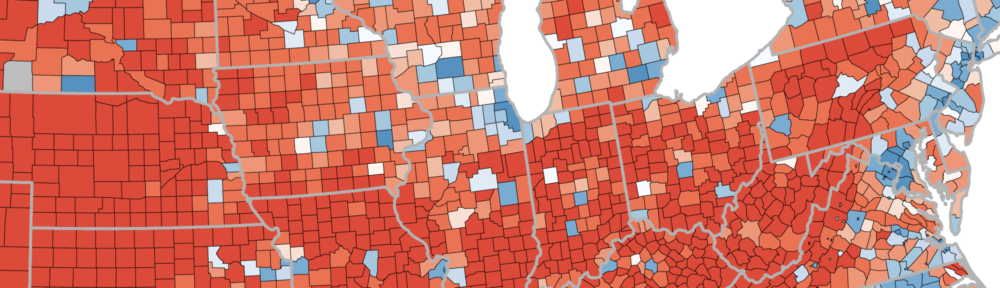
The geography of GOP defectors is interesting, especially three from New York (all in the south), three from Pennsylvania (all in the east) and three from Ohio (northeast and central). Also notable is the lack of defections through most of the south and west. (Credit the map to VoteView.com) (In the map OH15 looks like 2 districts because it has a very narrow waist connecting the east and west lobes of the district.)

Seventeen defectors hardly amounts to outright rebellion, though with the extraordinarily narrow GOP majority it easily swings the outcome of the roll call. These members have good reason to be concerned about their reelection prospects in November, and do not come from the most conservative wing of their party. Whether any suffer consequences from the leadership or the White House remains to be seen. When party unity has been so strong through 2025, this departure signals that members have concerns for voter reaction that can overcome party loyalty on some issues.

We also saw five Senate Republicans defect to advance a war powers resolution on January 8. And 35 Republicans voted to override Trump’s veto of a Colorado water project, with 24 voting to override a veto concerning tribal lands in Florida. While limited, this is more pushback from congressional Republicans than the Trump administration saw in the first year back in power.

Generic Congressional Ballot Review

The congressional generic ballot is one of the few indicators with a long history of non-presidential vote outcomes we have. I’ll look at how good a predictor it is at another time. Here is simply a review of the trends over each election cycle. The chart above shows each cycle since 1999-2000 until the current cycle, as of Oct. 5, 2021.

And for the obsessive, here is a chart of each cycle since 1945-46. It Is unreadable without zooming in, so download it and zoom as you wish.

The .pdf version is best for zooming in. You can download it here.

Updated 2021-10-06 to correct errors in 1981-82 chart.Thanks to @SteveEvets8 for spotting the errors.