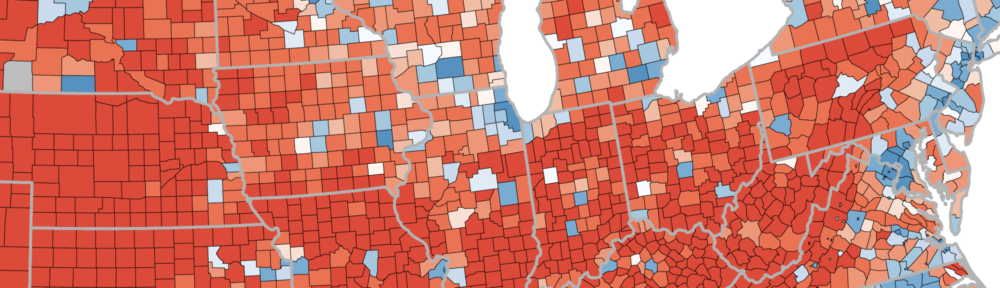
Wisconsin Assembly Top Races in 2026

Democrats must virtually run the table of competitive races to win a majority of seats

The redistricting of 2024 created a more competitive landscape for Wisconsin Democrats in the state Assembly. However, Republicans held on to the majority in 2024, winning 54 seats to 45 for Democrats. Prior to redistricting, in 2022 Republicans held 64 seats to 35 for Democrats. The ten seat swing has put the chamber in competitive territory for the first time since 2010, but Democrats must pick up five more seats to take the majority. To do that they must virtually run the table of competitive races.

The 2024 district lines, drawn from a plan of Democratic Gov. Tony Evers, made substantial changes to the 2022 lines, which were in turn very similar to the 2011 map adopted by the Republican trifecta under Gov. Scott Walker. The new maps have a more nearly even party balance given the voting history of the districts, with a slight Republican lean. The figure shows how each of the 99 districts has voted in 13 statewide races since 2012, plus the outcome of the 2024 Assembly election. Each open circle is a statewide race and the solid dots are the 2024 Assembly vote.

Districts are ordered by the number of Democratic victories in the 14 races, and by average Democratic minus Republican margin within the number of Democratic wins. There are 38 seats that have been won only by Republicans since 2012, and 35 that only Democrats have won. The potentially competive seats that have had mixed partisan outcomes amount to 26 districts, just over a quarter of the Assembly.

These mixed outcome seats produced 16 Republican wins and 10 for Democrats in 2024 under the new maps.

The next figure zooms in on just the mixed outcome seats. The asterisks mark the 9 seats that seem to potentially be the most competitive. Challengers, and potential incumbent retirements, are not yet clear across the races, so this analysis is simply looking at the voting history in these district.

Five of the nine most competitive seats are held by Republicans, with 4 Democrats. The table shows these seats and recent outcomes, sorted by Assembly vote margin in 2024. None won by as much as 3.5 percentage points, and all five Republicans are from districts Kamala Harris won in 2024, while one Democrat’s district was won by Donald Trump. On actual vote margin, all nine won by less than 1,200 votes.

Four of the five Republicans are from districts that voted for the Democrat for president in 2024 and for governor and U.S. Senate in 2022. One Republican district voted Republican for the Senate but Democratic in the other recent races. One Democrat is from a Trump district which split the 2022 vote, Democrat for governor but Republican for Senate. The other three Democrats are from districts with consistent Democratic majorities recently.Despite their somewhat Democratic leaning districts, each of these Republicans won in 2024. The Republican with the most challenging district, Todd Novak, in fact won with the largest margin of any of these races. Novak has successfully held a Democratic leaning district under the previous district lines as well. A reminder that candidates can win even in less congenial settings.

Some of these districts have been shifting over time, putting incumbents more at risk. The next figure shows how each district has voted since 2012, with the 2024 Assembly vote highlighted for comparison.

Four of the Republican seats have an obvious shift towards the Democrats over time: the 21st-Rodriguez, the 53rd-Kaufert, the 61st-Donovan, and the 88th-Franklin. Novak’s 51st is quite Democratic but hasn’t trended up or down since 2012. Based on the statewide races and trends, Franklin has the most competitive seat, while the other four Republicans are at significant disadvantage. Yet they each outperformed their party in 2024. Franklin’s extremely close race was still slightly better than Trump’s performance.

Of the Democrats, none of the districts are trending in a Republican direction, with all moving at least somewhat more Democratic. These Democratic incumbents closely matched Harris in 2024, while Doyle in the 94th did just enough better to win despite a 2-point Trump win. Whereas the Republican incumbents all outperformed their party, the Democrats fell a bit below where the partisan trend in their districts would expect.

Given the lean and trends in the districts, these five Republicans each face uphill battles in 2026, especially if they should draw strong Democratic challengers. Their incumbency advantage will be put to the test. For the Democrats, they have lagged their party a bit but don’t face hostile partisan environments.

Why not some other races?

The other districts that have a history of mixed-party outcomes could produce some competitive races in 2026, but their partisan environments are much less likely to flip a seat. The next figure shows the other 19 seats with mixed histories. Note the vertical scale is about twice as large as the previous figure, a tip-off that these are overall much less competitive seats even if they once in a while vote for both parties in statewide races.

Only a few of these suggest close districts, and none reveal a clear mismatch of incumbent and partisan lean. The ones that bear attention include Zimmerman in the 31st, Snyder in the 85th and Moses in the 92nd. Recent elections in Zimmerman’s seat have been close, with a slight Republican advantage, one that Zimmerman overperformed a little in 2024. Snyder’s 85th has a slight trend in a Democratic direction, though recent statewide races have all be close, with Snyder overperforming a bit. The 92nd, with Moses, shows a consistently close district with no trend up or down. Close enough to be potentially competitive in 2026.

Of the Democratic incumbents in the figure, Palmeri in the 54th somewhat underperformed in a pretty solidly Democratic district that shows no signs of moving toward the GOP. Likewise, Rivera-Wagner had a closer 2024 race than partisan patterns would suggest. In both these cases the significant partisan lean of the districts make it seem unlikely these would be good Republican pick-up opportunities.

The table shows these three Republican “maybe” seats, in the same format as above for the top races. While average margins have been relatively tight, only Gov. Tony Evers has managed to eke out two Democratic wins recently, and those by tiny margins. If incumbents retire, these might be Democratic pick up opportunities, but with a need for both good candidates and favorable national and statewide forces.

Bottom line

While Democrats have a shot at the Assembly majority, to do so they need to flip five Republican seats and not lose any current Democratic seats. The five Republican incumbents in the most competitive districts could provide those seats, though Doyle’s 94th district is a tough one for Democrats to hold on to. There could potentially be a close race in the “maybe” category of districts, but they are close districts with small GOP tilts. Possible retirements and quality of challengers will also make these races more (or less) competitive. There are also national and state level forces at play which favored Democrats in the 2025 elections elsewhere in the country. In short, the Democrats need a good year to run the table in competitive districts, and Republicans have a decent chance of preventing that given their candidates’ overperformances in the 2024 Assembly races.

Top Wisconsin Senate races, 2026

With 4 top races, Democrats need 3 wins to gain the majority

The Wisconsin state Senate is up for grabs in 2026, for the first time since 2012. There are four seats widely seen as the top competitive races, three held by Republican incumbents and one by a Democrat.

On January 22, one of those Republicans, Rob Hutton, R-Brookfield in the 5th district, announced he will not seek reelection. State Assembly Rep. Robyn Vining, D-Wauwatosa and community advocate Sarah Harrison have announced candidacies. The State Senate Democratic Committee has endorsed Vining.

Hutton’s district in a suburban area west of Milwaukee, in eastern Waukesha county. Yes, crucial Waukesha county.

In the Senate, three Republicans hold seats that Democrat Kamala Harris won in 2024, one of those held by Hutton. No Democratic incumbent holds a seat that Republican Donald Trump won in 2024. One Democratic incumbent holds a seat that was narrowly won by Harris. These four seats are widely seen as the top races in 2026. Hutton’s retirement can only make the race for the 5th more of a Democratic pickup opportunity.

The table lists these incumbents, their districts and the 2024 presidential vote margin, as well as cash on hand as of Dec. 31st. The 2026 Wisconsin Senate races are those in odd numbered districts. These senators did not face election in 2024 in their new districts. For that reason we measure competitiveness by the presidential vote margin in 2024 and any split between the incumbent’s party and the party of the presidential winner in that new district.

In 2024, Harris won SD5 by 6 percentage points, making it easily the most lopsided of the four battleground seats. The other two split outcome Republican seats were won by Harris by just 1 point each. The Democratic held seat, the 31st, was won by Harris by 2 points. That district will pit two incumbents against one another in 2026, with Sen. Jesse James choosing to give up his quite safe 23rd district to run against Jeff Smith in the close 31st.

All past votes in this analysis are votes for statewide candidates within the current district lines. This allows comparison of voting trends since 2012 for the current district boundaries. This makes it clear that the districts designed by Democratic Gov. Tony Evers in the 2024 redistricting have put all three Republicans in newly challenging districts. The figure shows the votes for statewide races since 2012 in the new district boundaries.

In Hutton’s 5th there has been a very strong movement away from GOP majorities to moderate Democratic wins since 2020. Marklein’s new 17th district has been strongly Democratic since 2012, though with a close Harris win in 2024. Marklein brings a large war chest to the race, in which he is facing Democratic Assembly Rep. Jenna Jacobson, D-Oregon. Wanggaard’s 21st has also drifted Democratic, though not so much as the 5th. (As of Jan. 22, Wanggaard has not announced his decision on seeking reelection.) Smith’s 31st is fairly Democratic in all elections since 2016, with a somewhat close Harris win in 2024. Large liberal margins in the 2025 Supreme Court race stand out in each of the 4 districts, though that race was more lopsided statewide than any other except the 2018 U.S. Senate election.

Given the close presidential margins in the 17th and 21st, it is plausible that incumbent Republicans could hold these seats, though the past voting record in the 17th is especially challenging.

Republicans currently have an 18-15 majority in the Senate, so Democrats have to win at least three of these four races to pick up a narrow majority.

House Retirements and Targeted Districts

While a substantial number of members of the House of Representatives are retiring, don’t expect these retirements to produce many flipped seats or shifts in the ideological makeup of either party.

As of January 13, 47 members of the House have announced their retirement, 21 Democrats and 26 Republicans. (I’m not counting resignations by Majorie Taylor Greene and Mikie Sherrill whose seats will be filled with special elections this year.)

The retirement rate has been running a bit ahead of recent cycles as of this date, which were 42, 34, 41, and 40 from 2018 to 2024. Still, I don’t think we are seeing extraordinarily high levels of retirements, as some commentary suggests. In the end those previous four cycles produced totals of 52, 36, 49 and 45 retirements, suggesting we may end up in the mid-to-upper 50s this year. Past retirements are from Ballotpedia.org.

The main point I want to make here is that the retirements are spread pretty widely throughout both Republican and Democratic caucuses by ideology and 2024 vote margin. The solid dots are retiring members. These are not endangered incumbents who barely scraped by in 2024, nor are they ideological outliers relative to their caucuses.

The figure shows all House members by vote margin and by left-right ideology, using Nokken-Poole dimension 1 ideology scores from VoteView.com. These scores are based on roll call votes by the members. Nokken-Poole is a variant of the widely used Nominate scores. Nokken-Poole scores range from -0.848 for the most liberal member to 0.986 for the most conservative member. Vote margin is the percentage for the Republican candidate minus the percentage for the Democrat, so negative margins are Democratic wins and positive ones are Republican victories.

Among Republicans, the median 2024 vote margin is 28.2 percentage points, and the median for retiring Republicans is 26.1 points. On ideology, the median Nokken-Poole score is 0.542 (higher scores are more conservative.) Among retiring Republicans the median is 0.581

Democratic retirees have somewhat larger vote margins, -36.8 percentage points, than their caucus as a whole, -27.0 points. On ideology, the retiring Democrats are also more liberal, -0.461, than the full Democratic caucus, -0.394. These are modest differences, however, and the figure makes clear retirements are well scattered throughout both caucuses.

The upshot of this distribution of retirements is that it does not open up many opportunities for turnover as most retirees enjoyed reasonably secure margins in 2024. Nor are retirements likely to significantly shift the ideological balance in the House given that retirees are ideologically pretty representative of their caucuses. While open races are less predictable than incumbent ones, the strong partisan lean of most of these districts means we should expect no more than a handful of these seats to potentially flip.

DCCC and NRCC target districts

Both the Democratic Congressional Campaign Committe (DCCC) and the National Republican Congressional Committee (NRCC) have released lists of districts being targeted as pick up opportunities. Compare this figure with the retirements above. The targeted districts are, as you would expect, far more concentrated in races that were narrowly decided in 2024. (These lists were released by the NRCC on March 17, and by the DCCC on April 8. They do not include changes or additions after some states redistricted in 2025. These are the members’ districts in the 119th congress.)

Republicans on the DCCC list have a median vote margin of 6.8 percentage points, much closer than the caucus median of 28.2 points. They are also less conservative, 0.384, than the full caucus, 0.542.

Democrats on the NRCC list also had much closer 2024 races, with a median of -3.2 percentage points compared to -27.0 for the full caucus. These Democrats are also less liberal than the caucus, with a median Nokken-Poole score of -0.221 compared to the caucus median of -0.394.

If you are looking for change in the House, look at the districts each of the parties are focusing on. They have a much greater chance of flipping than the seats of retiring members, and would be more likely to remove relatively moderate members of either party. The latter fact will also contribute to polarization in the House. Rather than target ideologically extreme members of the opposition party, both Democats and Republicans target close races, which also happen to be where the most relatively moderate members are.

Thirty years of Wisconsin Supreme Court Elections

Wisconsin’s Supreme Court elections were once low-key, low-turnout April affairs. Not so much any more. In 2023 total spending on the court race reached $50 million. Two years later, in 2025, total spending doubled that, passing $100 million. The big spending reflects the stakes in a shifting majority on the court. In the 2019-20 term, conservatives held a 5-2 majority. In 2020 liberals narrowed the conservative majority to 4-3. After the 2023 election it became a 4-3 liberal majority, which was maintained in 2025. With a retiring conservative justice, the 2026 election can either hold the 4-3 liberal majority or increase it to 5-2 for the 2026-27 term. (The seven justices are elected to 10 year terms.)

This recent shift contrasts with consistent conservative majorities from 1995 until the recent shifts. The figure shows the results of court elections since 1995. From 1995 through 2003 conservatives won 5 elections to 2 for liberals. From 2005 to 2013 conservatives again won 5 elections to 2 for liberals. But since 2015 liberals have won 5 seats to 3 for conservatives.

Since the 1990s Wisconsin Supreme Court elections have become far more partisan with voting patterns coming to be strongly linked to partisan elections and with the parties endorsing and financially supporting candidates in the formally non-partisan court races.

The next figure shows this changing partisan structure to court voting. As an example, I use Justice Ann Walsh Bradley, who won in 1995 and 2015 before retiring in 2025. (In 2005 she ran unopposed.) In 1995, there was a moderate correlation, .45, between how counties voted for the court race and how they voted in the previous presidential race. But by 2015, the correlation between Bradley’s vote and the 2012 presidential vote had risen to .78. In 2025 when Bradley retired, the correlation for liberal Susan Crawford with the 2024 presidential vote was an astonishing .99. This reflects the surge in party polarization in Wisconsin and the emergence of court races more tightly tied to partisan divisions.

This increase in partisan voting structure is not a sudden phenomena, but one which has grown steadily since the 1990s. In the 1970s and 1980s there was little partisan structure to court elections. Indeed, in 1978 the correlation was nil, .002. This rose sporadically in the 1990s, then grew steadily since 2007 to the current astonishingly high .99 of 2025.

This extremely high correlation doesn’t mean outcomes are locked in. Justice Brian Hagedorn, a conservative, won in 2019 by less than a 1 percentage point margin, with a correlation of .92 with the 2016 outcome, while Justice Rebecca Dallet, a liberal, won the year before with a 10 point margin and a correlation of .89 with the same 2016 presidential race. If all counties shift their votes up or down by the same amount, the correlation remains high though the outcome can shift, as in these two cases. Correlation tells us about the structure of the votes but not where the majority necessarily falls. What we have now is that the most Republican counties are now virtually certain to also be the most conservative in their court votes and the most Democratic counties the most liberal. That wasn’t the case before the 1990s when knowing a county’s presidential vote told us very little about their court vote.

The April 2026 election is likely to reflect this strong partisan structure of voting, though we can’t yet say if the net election forces will shift in the liberal or conservative direction.

The geography of the court vote has shifted dramatically over 30 years. In 1995, liberal Justice Bradley won with 55% of the vote. In 2025, liberal Justice Crawford replaced the retiring Bradley with a nearly identical 55% of the vote. But the sources of these two victories was dramatically different. In 1995, Bradley was strongly supported in the north, north-central, and southwestern parts of the state. Notably her vote was significantly less in Brown, Dane and Milwaukee counties. In 2025, Crawford lost badly in the north, north-central and most of the southeast, while she ran up large margins in Dane and Milwaukee, much more than Bradley’s 1995 totals in those counties. She also ran a little ahead in Brown, a county Bradley had lost badly in 1995. The maps shows how dramatically the geography of the vote has shifted even with identical vote margins in the two races.

With so much of the state shifting from blue to red, how is it that the vote margin is unchanged? Democratic gains have been large and come in counties with large populations. Republican gains are widespread but mostly in less populous counties. In large Republican leaning counties, Waukesha, for example, the conservative majority has increased but only slightly, with a larger increase in Washington, but a slight decrease in Ozaukee. Republicans have gained in Marathon, but the conservative margin is only moderate.In contrast, Dane has gone from pretty liberal to overwhelmingly liberal, and Milwaukee which was quite competitive has also become very liberal in its court vote. These shifts also highlight the greater geographic polarization in the 2020s compared to the 1990s, while not shifting the statewide balance at all.

Public opinion

Since 2023 the Wisconsin Supreme Court has held a consistent net approval rating, though about 15% say they don’t have an opinion. Court approval slightly improved during and after the 2025 court election, declining slightly in October.

As of October, the candidates for the court in 2026 were little known to the public. This is not unusual in court elections and especially so with no incumbent. The Marquette Law School poll in October asked registered voters if they had a clear idea what the candidates stand for. For both candidates, 69% said they hadn’t heard enough, and only 10% or 11% said they did have a clear idea. With less than 3 months left before the April election, the campaigns have a lot of messaging to do.

Voters have a strong preference that candidates for the court discuss issues so voters know what they stand for, 83%, while only 17% say candidates should avoid discussing issues so as to not appear to have prejudged issues. On this, partisans and independents are in agreement.

The balance of the court

With the current balance of the court, and the justices coming up for election in the next 10 years, the liberal majority is assured until at least 2028. Should the liberal candidate win in 2026 the majority will remain in liberal hands until at least 2030 (absent an unscheduled vacancy occuring.)

After more than two decades of conservative majorities, the liberal victories in five of the last eight court elections has altered the balance, and created the prospect for continued majorities well into the 2020s or beyond.

The shifting balance of the court since 2019 is shown in the table below.

And for those who want way more detail (you know who you are), here are all Wisconsin Supreme Court elections since 1976. My ideological classification of justices may be debatable in some cases prior to 2000. In those less partisan times ideology played less of a role and moderate justices may be mislabled. The distinctions since 1995 are much more clear, though note that Hagedorn was elected as a conservative candidate but does not align strongly with either the liberal or conservative wings of the court in his decisions, siding with conservatives a little more than half the time in some terms and a little more than half with liberals in other terms. See the excellent SCOWstats.com for detailed analysis of court alignments since 1918.

Extending ACA Tax Credits in the House

On January 8, the House passed a bill to extend enhanced Affordable Care Act subsidies for three years. Despite leadership opposition, 17 Republicans voted for the extension, a notable break with the party majority. An additional 5 Republicans did not vote. The bill’s prospects in the Senate are unclear as negotiations in that chamber continue.

Those Republicans voting for the bill had closer elections in 2024, and are less conservative than the GOP caucus as a whole. The Republicans who did not vote had larger 2024 vote margins and are somewhat more conservative than those who voted for the bill. The figure shows all members of the House. Those voting Yea are solid circles, Nays are open circles and non-voters are solid triangles. All Democrats voted for the bill.

For Wisconsin readers (and The Downballot fans like me) I’ve highlighted Derrick Van Orden, WI03, the only Republican from Wisconsin voting for passage. Van Orden won by the smallest margin (2.7 percentage points) of Republican House members in the state in 2024, and is a target for Democrats’ efforts to win the House in 2026. As with others voting to extend the tax credits, Van Orden is less conservative than the GOP caucus and had a close 2024 race.

The table shows all Republicans who voted for the tax credit extension, and those who did not vote.

The geography of GOP defectors is interesting, especially three from New York (all in the south), three from Pennsylvania (all in the east) and three from Ohio (northeast and central). Also notable is the lack of defections through most of the south and west. (Credit the map to VoteView.com) (In the map OH15 looks like 2 districts because it has a very narrow waist connecting the east and west lobes of the district.)

Seventeen defectors hardly amounts to outright rebellion, though with the extraordinarily narrow GOP majority it easily swings the outcome of the roll call. These members have good reason to be concerned about their reelection prospects in November, and do not come from the most conservative wing of their party. Whether any suffer consequences from the leadership or the White House remains to be seen. When party unity has been so strong through 2025, this departure signals that members have concerns for voter reaction that can overcome party loyalty on some issues.

We also saw five Senate Republicans defect to advance a war powers resolution on January 8. And 35 Republicans voted to override Trump’s veto of a Colorado water project, with 24 voting to override a veto concerning tribal lands in Florida. While limited, this is more pushback from congressional Republicans than the Trump administration saw in the first year back in power.

Family finances under Trump and Biden

Family financial situation in Wisconsin

The cost of living, or “affordability”, is at the top of public concerns likely to shape the 2026 elections. Let’s look back over the last decade for some perspective.

For the past 10 years my Marquette Law School Poll has asked Wisconsin registered voters about their family’s financial situation:

Thinking about your family’s financial situation, would you say you are living comfortably, just getting by, or struggling to make ends meet?

The percentage saying they were living comfortably rose steadily during the first Trump administration, from around 50% in 2016 to over 60% by 2020. But as inflation rose in 2021 the trend reversed, falling to 44% near the end of the Biden administration in late 2024. In the first year of the second Trump term the percentage living comfortably has turned up modestly, standing at 50% as of October.

Those who say they are just getting by reverse the pattern for those living comfortably, declining from 2016-20, rising from 2021-24, with a slight downturn in 2025. Those struggling also move in rough parallel with those just getting by.

The decline in financial well-being during the Biden administration goes a long way to explaining Biden’s low approval rating during the last three years of his administration and Trump’s ability to win Wisconsin in 2024 by 0.9 percentage points, after having lost the state by 0.6 points in 2020.

The upturn in financial situation in 2025 contrasts with continued worries about inflation and the cost of living, which was the most cited problem in the October Marquette poll, at 27%, with an additional 9% citing the economy as most important. These concerns are substantial across the usual partisan lines: 23% of Republicans rank inflation as most important, as do 27% of independents and 32% of Democrats. Only Republicans rank another issue higher, immigration, at 31%.

What lies behind the changing sense of financial security or insecurity over the past decade? Partisanship plays a big role, as does income.

Family finances by party identification

The upturn in sense of living comfortably in 2025 is entirely due to Republicans who turned sharply more positive with the change of administration in January. By the end of the Biden administration only about 34% of Republicans said they were living comfortably, but by October this had soared to 63%.

In contrast, independents living comfortably declined throughout the Biden administration and show no upturn in 2025. Democrats viewed their financial situation as stable through the Biden years with a substantial downturn in 2025.

There is no evidence these changes in perceived financial situation reflect real fluctuations in income. In 2024, 37% of Republicans reported family incomes over $100,000, and 37% had that income in 2025. For independents, 28% had this level of income in both 2024 and 2025. Slightly more Democrats had incomes over $100,000 in 2025, 34%, than the 32% in 2024.

Family finances by income

This powerful effect of partisanship does not mean money doesn’t matter. Those living comfortably rises with income while those struggling goes down as income rises. More important is the changing sense of well-being over time and especially during the Biden years. Across each income level the percentage living comfortably fell during Biden’s term after rising during Trump’s first term. Those struggling declined or was flat during Trump’s first term but rose under Biden, especially for lower income families, though also for those of middle-income. For the high income group a decline in living comfortably translated into a rise in the feeling of just getting by. In 2025 all income groups show at least a small increase in sense of living comfortably and a downturn in those saying they are struggling.

Family finances by party ID and by income

We can disentangle the income and partisan effects a bit by looking at both simultaneously. Republicans, regardless of income, showed declining financial well-being throughout Biden’s term and have shown an improved outlook in 2025. (The data here are aggregated by year to provide enough cases to reliably estimate both partisan and income effects simultaneously.)

Both low- and high-income independents had declining finances in 2021-24 and continued down in 2025. Middle-income independents seem a bit better off in 2024 and 2025 than earlier in Biden’s term.

Low- and high-income Democrats held stable in their sense of family finances under Biden, with both dropping off a bit in 2025 under Trump. This contrasts with middle-income Democrats who felt increasingly worse off under Biden and are continuing down under Trump.

Not to be missed in all these details is that among Republicans and independents every income group felt their financial situation was better during Trump’s first term than during Biden’s. Democrats were more stable during the Biden years, with the important exception of middle-income Democrats who felt increasingly worse off.

Finances, party and the vote

The sage said, “it’s the economy, stupid” and this seems to hold up today as it did in the 1990s. If not the only thing that matters, these shifts in financial security from 2021-24 surely go a long way to pointing us to crucial groups who found themselves feeling worse off in 2024 than in 2020. This was especially true for middle-income people who reported being less secure regardless of party by 2024. For Republicans this reinforced their partisan inclinations while for Democrats greater insecurity is associated with a modest increase in votes for Trump, and likely reduced turnout: among Democrats living comfortably, 96% said they were certain to vote in 2024, while among those struggling 86% said the same. Turnout increased slightly for struggling Republicans vs comfortable ones, while turnout was lower for struggling independents than those living comfortably.

Voting for Trump was higher in 2024 for those struggling compared to the comfortable across parties, with modest differences among Republicans and Democrats but a large 40-point increase for Trump among struggling independents vs. comfortable ones.

The lesson for 2026 and beyond: “it’s the economy, stupid”.

Midterm seat losses, 1862-2022

The president’s party almost always suffers in the House

Midterms are less than a year away so it’s time to look back at the record. 

In the House, the president’s party has lost seats in all but four midterms since 1862, and one of those, 1902, was a year the House expanded so the Republican gains fell short of Democratic gains that year. After 1934 it wasn’t until 1998 that the president’s party gained seats, then the rare event repeated in 2002. Not since.

This regularity over 160 years is hard to attribute to the circumstances of the moment. Likewise the hope that “this year will be different” has been a forlorn one. The size of the seat loss, on the other hand, has varied considerably and is correlated with presidential approval (Clinton in 1998 and Bush in 2002 were unusually popular, as was Roosevelt in 1934) and the state of the economy. Popular presidents lose fewer seats, unpopular ones more. Good times go with smaller losses, bad times with greater losses. 

In 2026 we will have the unprecedented circumstance of a large number of mid-decade redistricting decisions as the parties battle to see who can gerrymander the most seats to their advantage. That landscape is still being painted.

In the Senate the pattern of losses are much less dependable than in the House. The president’s party usually loses seats, and the gains have been small since the 1940s. The vagaries of which seats are up and how many for each party adds uncertainty to the Senate picture. And, of course, prior to 1913 the Senate was not elected by popular vote.

In the House, the second midterm for a president produces barely grater losses than the first midterm (an average of 28.9 in the second, versus 24.9 in the first.) There isn’t a “six-year itch” on the House side. The Senate has been a different matter, with second midterm losses averaging 6 seats rather than 2 in the first midterm (since 1946.) One plausible explanation for the Senate is that the 6th year is the reelection of a Senate class elected with the president for his first term. To the extent a winning first term president brings along some partisan companions, they run without his coattails 6 years later. The table shows the seat changes and the averages since 1946.

Next year there will be inevitable discussion of whether 2026 is Trump’s second midterm. Obviously it is in one sense. But for the Senate, this will be the class elected with Joe Biden in 2020, not the class elected with Trump in 2016. This group had mild pro-Democratic national forces either helping or hurting them in 2020. Given this difference in the election cycle, the average 6 seat loss may not be as good a representation of expectations for Senate seats in 2026.

No second acts: Repeat performances in Wisconsin elections

Is the second time the charm?

They say there are no second acts in politics. In Wisconsin that has been the case for the last 27 years, at least when it comes to statewide contests for governor and U.S. Senate. Mandela Barnes’ entry in the 2026 governor’s race will attempt to break the dismal recent record.

Consider the examples of Tom Barrett (lost governor’s races in 2010 and 2012), Tim Michels (lost Senate race in 2004 and lost governor’s race in 2022), Russ Feingold (lost Senate races in 2010 and 2016), Eric Hovde (lost GOP primary for Senate in 2012, lost Senate race in 2024), and Mark Neumann (lost Senate race in 1998, lost GOP primary for governor in 2010 and lost GOP primary for Senate in 2012). Even Tommy Thompson, who won four races for governor, fell short 14 years later in his 2012 bid for the Senate. You have to go back to the 1970s to find a successful second act in Wisconsin statewide elections.

What does this record say about Barnes’ position in the 2026 race for governor? There are some advantages that are important. He will likely start out as the best known candidate in a field of some 7 or 8 candidates. In my Marquette Law School Poll of Wisconsin, Oct. 15-22, the three best known Democrats had name identification ranging from 22% (Hong) to 25% (Rodriguez) to 26% (Crowley), with the rest in the teens. Barnes was not included as he had not entered the race. At the end of his 2022 Senate race, Barnes had a name ID of 85%, though when he started that race as the sitting Lt. Governor his ID rate was 37% in Feb. 2022. There is falloff in ID between races. Barrett finished his 2010 governor’s race with 84% name recognition, which fell to 61% in Jan. 2012 at the start of the recall election. Feingold fell from 95% in 2010 to 75% in Jan. 2016.

In two recent polls that included his name (though unannounced at the time) Barnes was ahead in the Democratic primary field with 16% support in a Sept. 28-30 poll sponsored by Platform Communications and ahead with 21% in a TIPP poll conducted Nov. 17-21. In both polls all other candidates were below 10%, with a third to half of voters undecided. Those polls didn’t measure name recognition.

Barnes also has the advantage of having raised substantial money in his 2022 Senate bid, giving him a donor list to tap that none of the other candidates have.

Those are positive elements for Barnes and each gives him an initial advantage some eight months ahead of the primary.

The reason for doubt is the track record of candidates running statewide following a previous statewide loss. The second time around has not shown much improvement in general election vote percentage (though each won their second round primaries, except for Neumann).

Name ID

Repeat candidates begin their second races with lower name ID than when they finished their first race, with slippage of about 20 points for Barrett and Feingold. Hovde began both races with very low name ID. All ended their second races with high name ID, though Feingold didn’t quite reach the high levels he had in 2010.

Barnes began his 2022 Senate race with a name ID rate in the mid-30s, rising to the mid-80s. We don’t yet know how much that has declined since 2022.

The chart shows the changes in name ID across the year leading up to each election. There is need to rebuild name recognition in the second act, but candidates largely succeed in doing so, and start with a higher level than first time candidates.

Net favorable ratings

Each of these candidates has suffered declines in net favorability across their elections. Decline late in the campaign is apparent for each candidate. Feingold stands out for having net positive favorability in both races he lost. The others all ended in negative territory, with Barrett and Hovde more net negative in their second races than in their first. Feingold’s first and second are about equal.

Bottom line

We don’t know how the next eight months until the primary, and eleven months to the general election, will unfold. What these past second acts have shown in that initial advantages in name ID and campaign experience, including established donors, have not produced success in the second campaigns over the past quarter of a century. Barnes now has the chance to change that somewhat daunting record.